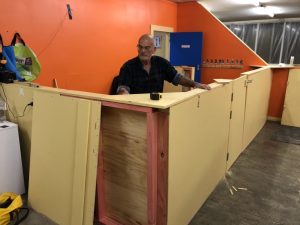

“If you’re going to have a reception desk, it needs to be wheelchair accessible.” That was the council and that threw a spanner in the works. The building itself had three steps up at the entrance. So realistically, no wheelchair could get into the space anyway. But rules are rules. So I had to modify the desk to technically comply — creating a lower signing surface in case someone needed to sign something off at an accessible height. It was another one of those “figure it out and move on” moments.
Throughout the entire build, we were constantly talking with the council. Some things were approved easily. Some things weren’t. Some required adjustments. It was a steady stream of “yes… but,” and “no… unless.”
When it came to the flooring, we had a few options.
We rejected the laying new vinyl as we didn’t know how it would handle dog claws. We’d also heard feedback from other daycare centres that they’d got less than 2 years out of vinyl.
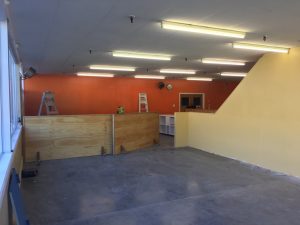
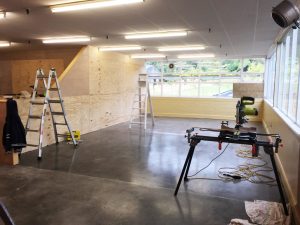
We ended up grinding and polishing the entire concrete floor. That decision had its pros and cons — it was durable and easy to clean – pee was easy to spot, but not exactly warm and cosy in winter. Still, it worked. And at that stage, if it worked, it was good enough.
Every decision felt big because there was no template to follow. We weren’t buying into a franchise. We weren’t copying someone else’s layout.
Looking back, it was probably a good thing. It forced us to really think about what we were building.
Somewhere in the middle of fencing, flooring, and council compliance, we had to answer the big question:
How is this actually going to work?
We knew early on what our staff-to-dog ratio would be.
We chose to follow the Canadian temporary housing guidelines, which clearly outlines best practice for daycare and boarding environments. For daycare, we committed to running at a 15:1 staff ratio.
That wasn’t necessarily the cheapest way to do it. But it was the safest.
And from the very beginning, we wanted safety and quality to define us — not cutting corners.
Pricing, space allocation, transport routes — those all evolved over time. But the ratio decision was foundational. It shaped staffing, it shaped revenue projections, and it shaped the type of experience we wanted to deliver.